
Why Dubai Companies Are Shifting to Offshore Workforce Solutions?
Discover why Dubai companies are adopting offshore workforce solutions to improve scalability, access talent, and support business growth.
5/19/20266 min read
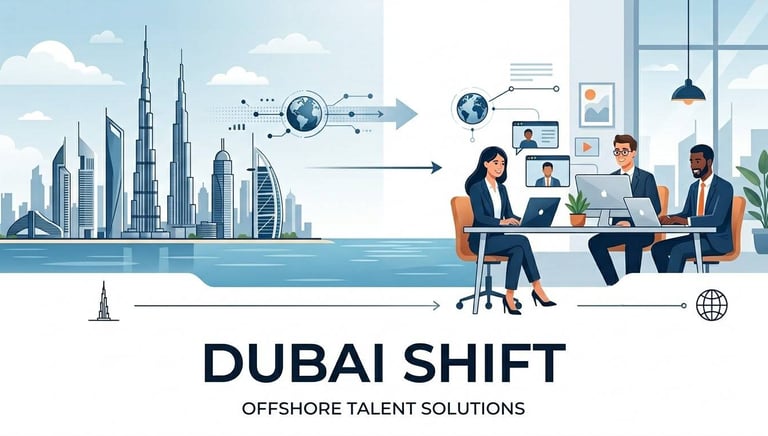
Dubai companies are increasingly adopting offshore workforce solutions to manage operational pressure, access specialized talent, and maintain business continuity in a competitive regional market. Rising digital workloads, extended customer service expectations, and the need for scalable support functions have pushed many organizations to distribute operations across offshore teams rather than relying entirely on local hiring.
This shift is especially visible in industries such as e-commerce, logistics, fintech, consulting, and customer service. Offshore workforce models now support technical operations, data management, remote administration, and multilingual customer support without disrupting local compliance structures. Businesses evaluating this model require accurate operational planning, workforce alignment, and secure communication systems to avoid common outsourcing failures.
Why Offshore Workforce Models Are Expanding in Dubai?
Dubai’s business environment moves quickly. Companies often face sudden spikes in customer demand, regional expansion requirements, and digital transformation projects that require specialized support teams. Offshore workforce solutions help businesses handle these operational shifts with greater flexibility.
According to Deloitte, global outsourcing adoption continues to increase because organizations prioritize operational agility and access to skilled talent pools. Similarly, PwC Middle East has reported growing regional investment in digital operations and remote workforce integration across GCC markets.
Key Drivers Behind the Shift
Difficulty hiring niche technical talent locally
Offshore markets provide faster access to specialized professionals with technical expertise.Need for 24/7 support coverage
Distributed offshore teams help businesses manage operations across multiple time zones.Increasing digital workload
Offshore workforce solutions efficiently handle repetitive operational and administrative tasks.Business expansion across GCC markets
Remote support teams scale operations faster than traditional local hiring processes.Administrative overload
Delegating backend functions allows internal teams to focus on strategic business priorities.
Industries Leading the Transition
E-commerce
Common offshore functions include customer support, order processing, and data entry management.IT Services
Businesses offshore technical support, software monitoring, and quality assurance testing operations.Real Estate
Offshore teams often manage CRM systems, lead qualification, and administrative coordination.Healthcare Administration
Common outsourced functions include documentation processing and appointment scheduling support.Financial Services
Companies frequently offshore data management and compliance documentation assistance.
How Offshore Workforce Solutions Improve Operational Stability?
Many Dubai businesses initially viewed offshore staffing as a cost-focused decision. Current adoption patterns show a different trend. Operational continuity and scalability have become stronger motivators than basic workforce expansion.
Faster Business Scalability
Offshore teams allow organizations to increase operational capacity without restructuring entire internal departments. This becomes particularly important during seasonal demand fluctuations or rapid market growth.
For example, customer support departments often require immediate scaling during product launches or regional campaigns. Offshore teams can absorb increased ticket volume while local leadership maintains strategic oversight.
Access to Specialized Talent Pools
Dubai companies frequently require expertise in cloud support, CRM administration, multilingual communication, cybersecurity monitoring, and data processing. Offshore workforce models provide access to professionals trained specifically in these areas.
Improved Workflow Distribution
Organizations operating entirely through local teams often experience workflow bottlenecks. Delegating repetitive or process-driven tasks offshore allows internal departments to focus on higher-level operational priorities.
Bonus Tip: Businesses achieve stronger offshore integration when standard operating procedures are documented before onboarding external teams. Unstructured workflows create communication gaps and inconsistent outcomes.
Offshore Workforce Models Compared With Traditional Local Hiring
Recruitment Speed
Offshore workforce solutions provide faster access to large international talent pools, while traditional local hiring often involves longer recruitment cycles.Operational Flexibility
Offshore teams are easier to scale based on business demand, whereas local hiring is usually limited by office space and internal infrastructure.Time Zone Coverage
Offshore workforce models support extended operational hours across multiple regions, while local teams generally operate within standard business hours.Specialized Skill Access
Offshore staffing offers broader access to specialized global expertise, compared to the limited availability of niche talent locally.Infrastructure Dependency
Offshore operations reduce dependence on physical office infrastructure, while traditional hiring requires greater workspace and facility management.Workforce Continuity
Distributed offshore teams improve operational resilience during staffing shortages, whereas local-only models face higher disruption risks.
Technical Areas Businesses Commonly Offshore
Operational success depends on selecting the right functions for offshore execution. Businesses typically outsource process-driven tasks with measurable workflows.
Customer Support
Offshore suitability remains high because support operations rely on standardized communication processes. Businesses require structured communication systems to maintain response quality and service consistency.IT Monitoring
Technical monitoring functions are highly suitable for offshore teams when secure remote infrastructure and controlled system access are in place.Data Management
Offshore teams commonly handle data processing, database updates, and CRM maintenance. These operations require clearly defined data governance and security policies.HR Administration
Human resource support functions have moderate offshore suitability. Businesses must ensure compliance alignment, documentation accuracy, and proper workflow supervision.Strategic Leadership
Strategic decision-making roles generally have low offshore suitability because they require direct local executive oversight, internal coordination, and business leadership involvement.
Operational Risks Companies Must Address
Offshore workforce strategies fail when businesses prioritize speed over operational structure. Clear governance remains essential.
Communication Gaps
Poor onboarding procedures create delays, duplicate work, and inconsistent service delivery. Businesses require centralized communication systems and documented escalation processes.
Data Security Concerns
Organizations handling sensitive customer information must establish secure access protocols, role-based permissions, and compliance monitoring systems.
According to IBM Security, human error and process weaknesses remain major contributors to operational data exposure incidents globally.
Workflow Fragmentation
Disconnected tools and unclear reporting structures reduce efficiency. Offshore teams perform better when integrated directly into existing project management systems.
Bonus Tip: Businesses should start with one operational department before scaling offshore support across multiple divisions. Pilot programs identify workflow weaknesses early.
Workforce Support Areas Frequently Managed Offshore
Workforce Acquisition
Remote recruitment support helps businesses identify qualified candidates for technical, administrative, and multilingual roles while reducing internal hiring pressure.
Customer Support
Distributed customer service teams assist with ticket handling, live chat operations, and multilingual communication coverage across different time zones.
IT and Tech Support
Offshore technical teams commonly handle infrastructure monitoring, software support, troubleshooting coordination, and routine maintenance tasks.
Data Management
Businesses increasingly offshore documentation handling, database updates, CRM maintenance, and operational reporting functions to maintain workflow consistency.
Factors Businesses Should Evaluate Before Transitioning Offshore
Not every operational process should move offshore immediately. Companies achieve stronger long-term outcomes when offshore planning aligns with operational maturity.
Questions Decision-Makers Should Evaluate
Workflow Documentation
Clear process documentation prevents operational confusion, reduces onboarding delays, and improves workflow consistency across offshore teams.Data Sensitivity
Businesses must evaluate the type of information being handled to determine appropriate security protocols and compliance requirements.Communication Structure
A defined communication framework supports accountability, faster issue resolution, and smoother coordination between local and offshore teams.Technology Stack Compatibility
Compatible systems and software reduce integration challenges and improve operational efficiency across distributed teams.Performance Monitoring
Regular performance tracking helps maintain service quality, operational transparency, and long-term workflow stability.
Internal Readiness Matters
Organizations with unclear internal workflows often struggle during offshore transitions. Businesses should standardize reporting systems and operational procedures before expanding into distributed workforce models.
Bonus Tip: Weekly operational review meetings significantly reduce offshore coordination delays during the first 90 days of implementation.
Common Questions Businesses Ask Before Transitioning Offshore
How long does offshore team integration usually take?
Most businesses require several weeks to fully align communication processes, reporting structures, and workflow systems.
Which departments are easiest to offshore first?
Customer support, data processing, and administrative operations typically transition more smoothly because workflows are easier to standardize.
Does offshore staffing reduce operational control?
Operational control depends on governance systems rather than workforce location. Structured reporting and documented KPIs maintain accountability.
What causes most offshore workforce failures?
Poor communication systems, undefined expectations, and weak onboarding processes create the majority of operational problems.
What Businesses Continue Asking After Implementation
How can offshore teams maintain consistent service quality?
Consistent quality depends on ongoing performance reviews, process documentation, and centralized communication systems.
Should offshore teams use the same tools as local departments?
Yes. Unified project management and communication platforms improve collaboration and reporting accuracy.
How often should offshore workflows be reviewed?
Quarterly operational reviews help businesses identify process inefficiencies and training requirements.
Can offshore workforce models support long-term growth?
Yes. Many companies gradually expand offshore support functions after successful pilot implementations.
What skills are most commonly outsourced today?
Technical support, multilingual customer service, CRM management, data handling, and digital operations support remain the most commonly outsourced functions.
Final Thoughts
Dubai companies are shifting toward offshore workforce solutions because operational flexibility has become essential for sustainable growth. Businesses now prioritize scalability, specialized expertise, workflow continuity, and distributed operational resilience over traditional staffing limitations.
Successful offshore integration depends on preparation, communication structure, data governance, and realistic operational planning. Organizations that standardize workflows before expanding offshore typically experience stronger long-term performance and fewer operational disruptions.
Speak With RD Global Business Solution
RD Global Business Solution supports businesses managing operational expansion through structured offshore workforce services including Workforce Acquisition, Customer Support, IT & Tech Support, and Data Management. Organizations evaluating offshore workforce integration strategies can discuss workflow planning, operational alignment, and support structures by contacting RD Global Business Solution at info@rdglobalbizsol.com or calling +971566249846.
Empowering your business with operational excellence solutions.
Al Moosa tower - 810 - 1 Sheikh Zayed Rd - Dubai








Solutions
Company
Contact
© 2026 RD Global Solutions. All Rights Reserved.


+971 56 624 9846

info@rdglobalbizsol.com