
Offshore vs In-House Teams: Which Is Better for Business Growth?
Compare offshore vs in-house teams to find which drives better business growth, scalability, control, and efficiency for modern companies. Strategic guide.
5/18/20264 min read
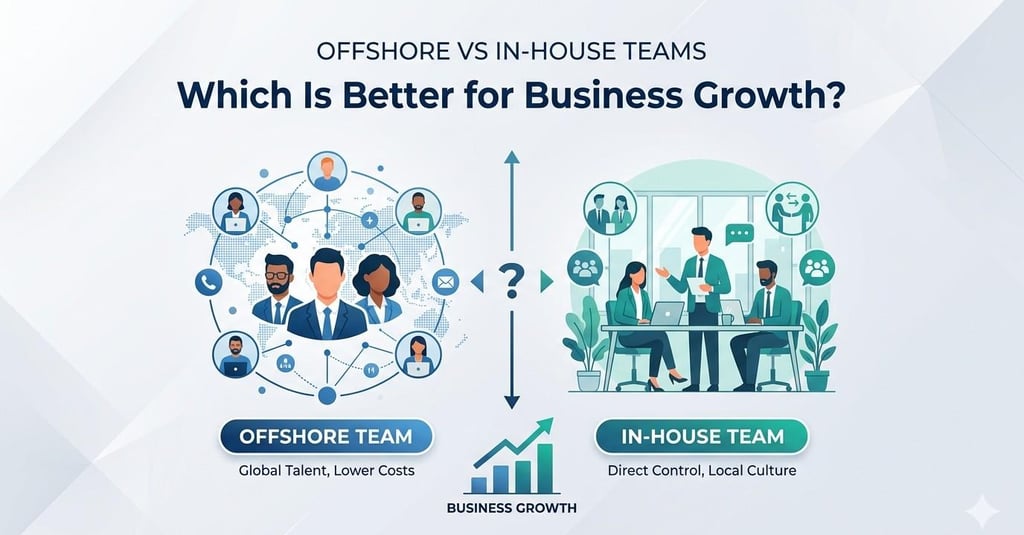
Business growth depends heavily on how efficiently teams operate, communicate, and scale. Offshore teams usually provide flexibility, faster scaling, and access to specialized talent across different regions. In-house teams offer stronger cultural alignment, direct supervision, and tighter operational control. Neither model works universally for every business. The better option depends on operational goals, project complexity, compliance requirements, and growth stage.
Organizations handling repetitive operational tasks, technical support, customer communication, or data processing often benefit from offshore support structures. Businesses requiring sensitive decision-making, rapid internal collaboration, or strict regulatory oversight may perform better with in-house teams. In practice, many growing companies now combine both approaches to improve scalability while maintaining control over core operations.
This article explains the operational differences, long-term growth impact, risk factors, and practical considerations involved in choosing between offshore and in-house teams. The insights reflect common workforce management patterns observed across technology, customer support, and operational service sectors.
Understanding How Offshore and In-House Teams Operate
Offshore teams
Offshore teams operate from another country or region while supporting business functions remotely. These teams commonly manage:
Technical support
Customer service
Administrative operations
Data processing
Software development
Back-office tasks
Businesses typically use offshore structures to improve operational coverage across time zones and reduce internal workload pressure.
In-house teams
In-house employees work directly under the company’s internal management structure. These teams usually handle:
Strategic planning
Leadership functions
Product management
Sensitive operations
Compliance-heavy activities
Core decision-making
In-house environments often improve communication consistency and internal accountability.
Key Operational Differences That Affect Growth
Offshore team advantages
Faster workforce expansion during growth periods
Broader access to international skill sets
Extended operational coverage across time zones
Reduced hiring and infrastructure pressure
Easier scalability for repetitive workflows
Offshore team limitations
Communication delays across regions
Cultural and language differences
Dependency on remote collaboration systems
Increased cybersecurity oversight requirements
In-house team advantages
Direct management visibility
Stronger organizational culture
Faster internal decision-making
Easier collaboration between departments
Better oversight of confidential operations
In-house team limitations
Slower hiring cycles
Higher operational overhead
Limited local talent pools
Reduced scalability during rapid expansion
Business Functions Better Suited for Each Model
Operational suitability across business departments
Customer Support
Offshore Teams: Highly suitable
In-House Teams: Suitable
IT Support
Offshore Teams: Highly suitable
In-House Teams: Suitable
Strategic Planning
Offshore Teams: Limited suitability
In-House Teams: Highly suitable
HR Leadership
Offshore Teams: Limited suitability
In-House Teams: Highly suitable
Data Entry & Processing
Offshore Teams: Highly suitable
In-House Teams: Suitable
Product Development
Offshore Teams: Moderate suitability
In-House Teams: Highly suitable
Compliance Operations
Offshore Teams: Moderate suitability
In-House Teams: Highly suitable
Administrative Support
Offshore Teams: Highly suitable
In-House Teams: Suitable
According to a 2025 report by Deloitte, scalability and operational flexibility remain the leading reasons companies adopt offshore workforce models. Remote workforce integration also continues to rise globally due to digital collaboration tools and hybrid operating systems.
When Offshore Teams Drive Better Growth Outcomes
Businesses scaling rapidly often struggle with recruitment speed, workload distribution, and operational continuity. Offshore teams help reduce these bottlenecks.
Common growth situations where offshore teams perform well
Expanding customer support availability
Managing seasonal workload spikes
Supporting 24/7 technical operations
Handling repetitive administrative tasks
Processing large operational datasets
Bonus tip
Companies using offshore support for customer service achieve better response continuity when overlapping regional shifts are implemented instead of relying on single-region scheduling.
Research published by Statista shows that global outsourcing adoption continues increasing across IT support, customer experience, and administrative functions due to workforce flexibility demands.
When In-House Teams Create Stronger Long-Term Stability
Some business activities require deep organizational understanding, direct leadership oversight, and constant collaboration. In-house teams often perform better in these areas.
Situations where in-house structures work best
Intellectual property management
Leadership and strategic direction
Regulatory decision-making
High-security operations
Product innovation planning
Bonus tip
Businesses managing sensitive internal systems often separate strategic control internally while outsourcing support operations externally. This hybrid structure reduces operational strain without weakening governance.
Factors That Influence Team Performance
Communication Speed
Offshore Teams: Moderate
In-House Teams: High
Workforce Scalability
Offshore Teams: High
In-House Teams: Moderate
Management Control
Offshore Teams: Moderate
In-House Teams: High
Flexibility
Offshore Teams: High
In-House Teams: Moderate
Infrastructure Dependency
Offshore Teams: Low
In-House Teams: High
Cultural Alignment
Offshore Teams: Moderate
In-House Teams: High
Time Zone Coverage
Offshore Teams: High
In-House Teams: Limited
Data Oversight Complexity
Offshore Teams: Higher
In-House Teams: Lower
A 2025 workforce study by Gartner noted that hybrid workforce models continue outperforming fully centralized structures in operational adaptability and workforce resilience.
What Businesses Should Evaluate Before Choosing
Important operational considerations before making a workforce decision
Define whether the role supports core strategy or operational execution
Assess data security and compliance requirements
Evaluate internal management capacity
Review communication dependencies between departments
Determine scalability requirements over the next 12–24 months
Analyze workflow standardization levels
Consider regional labor regulations and operational continuity
Bonus tip
Processes with clearly documented workflows transition more successfully to offshore environments than loosely structured operational tasks.
Operational Support Services Commonly Used During Workforce Expansion
Workforce support areas frequently used during scaling
Virtual Office Setup
Supports distributed operations by creating structured administrative presence for remote workforce coordination.Workforce Acquisition
Helps businesses identify operational talent for customer support, technical operations, and administrative functions.Customer Support
Assists businesses managing increasing communication volume across multiple channels and time zones.IT & Tech Support
Maintains operational continuity for remote infrastructure, troubleshooting, and digital systems management.
RD Global Business Solution supports businesses managing distributed operational structures across multiple service environments.
Questions Decision-Makers Usually Ask Before Choosing
Should a business offshore critical operations immediately?
Critical operations typically require internal stabilization first. Businesses often offshore standardized support functions before transitioning more sensitive operations.
Does offshore management reduce operational visibility?
Visibility depends more on reporting systems and workflow structure than location alone. Performance tracking tools significantly improve remote oversight.
Can small businesses manage offshore teams effectively?
Smaller businesses often succeed with offshore support when workflows are clearly documented and communication systems are centralized.
Is a hybrid workforce model becoming more common?
Yes. Many organizations now combine offshore support functions with internal strategic leadership to improve flexibility and operational resilience.
Answers to Long-Term Workforce Management Questions
How can businesses maintain quality control with offshore teams?
Consistent documentation, performance benchmarks, and centralized communication systems improve long-term operational quality.
What causes offshore workforce projects to fail?
Poor onboarding, unclear workflows, inconsistent reporting, and weak management structures are common failure points.
How often should workforce structures be reviewed?
Operational reviews every six to twelve months help businesses adjust staffing models based on growth and workload shifts.
Do offshore teams affect customer experience quality?
Customer experience depends more on training quality and workflow consistency than geographic location.
What skills remain better managed internally?
Leadership, strategic planning, compliance oversight, and confidential decision-making functions usually remain more effective internally.
Final Thoughts
Offshore and in-house teams each support business growth differently. Offshore structures improve scalability, operational flexibility, and workforce availability. In-house teams strengthen organizational alignment, control, and strategic collaboration. Businesses achieve stronger long-term outcomes when workforce decisions align directly with operational complexity, communication needs, and future expansion goals.
The most effective workforce structure is usually the one that supports sustainable growth without creating operational strain or management inefficiencies.
Discuss Workforce Planning Requirements
RD Global Business Solution assists businesses evaluating offshore and in-house workforce structures for long-term operational growth. Businesses seeking operational guidance, workforce planning support, or structured implementation strategies can directly reach RD Global Business Solution via email at info@rdglobalbizsol.com or by phone at +971566249846 to discuss operational requirements and business scalability objectives.
Empowering your business with operational excellence solutions.
Al Moosa tower - 810 - 1 Sheikh Zayed Rd - Dubai







Solutions
Company
Contact
© 2026 RD Global Solutions. All Rights Reserved.

+971 56 624 9846

info@rdglobalbizsol.com