
How do offshore solutions support Dubai real estate?
Explore how offshore solutions help real estate companies in Dubai manage assets, ensure compliance, streamline ownership, and improve investment efficiency.
6/3/20264 min read
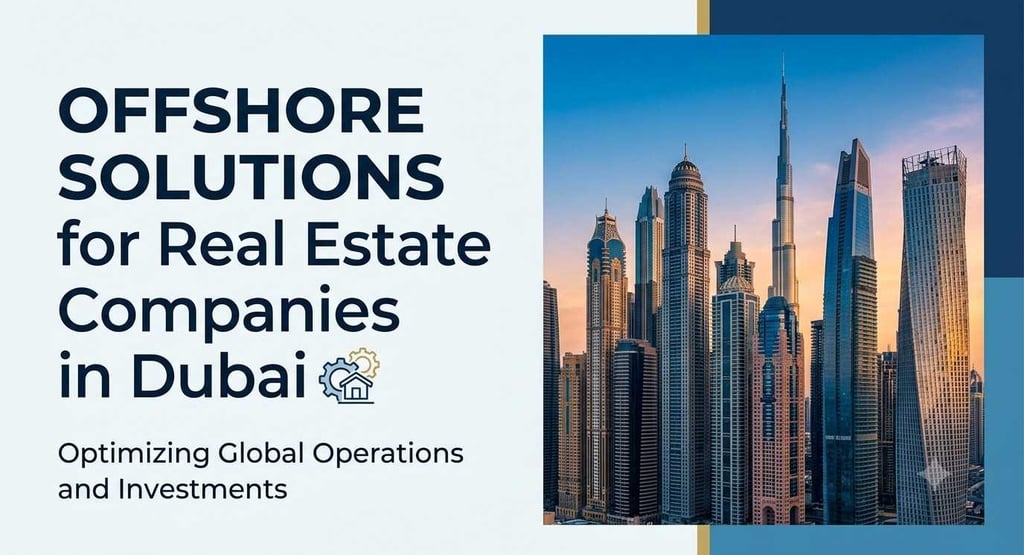
Offshore structures for real estate companies in Dubai are designed to simplify ownership holding, asset protection, and international investment management. These setups help real estate businesses separate operational activities from asset ownership while maintaining compliance with UAE regulatory frameworks. Offshore solutions are commonly used for holding properties, managing cross-border investors, and streamlining administrative processes without requiring a physical office presence.
Expertise in UAE corporate structuring and real estate regulatory alignment ensures that offshore setups remain compliant with authorities such as the Dubai Land Department (DLD) and relevant free zone regulators. Offshore solutions also support smoother banking access, structured reporting, and governance efficiency for real estate portfolios operating across multiple jurisdictions.
How offshore structures support real estate operations in Dubai
Offshore entities function as holding or administrative vehicles rather than operational trading companies. In real estate, this model is used to hold property assets, manage shareholder arrangements, and reduce administrative complexity.
These structures are widely used when investors require confidentiality, centralized asset control, or multi-property ownership consolidation. Offshore setups also help separate high-value assets from operational liabilities, reducing exposure to business risk.
Dubai’s regulatory environment supports structured ownership through jurisdictions such as JAFZA Offshore and RAK ICC, both commonly used for real estate holding purposes.
Key offshore jurisdictions used for real estate holding
Different offshore jurisdictions in the UAE offer varied advantages depending on investor goals, compliance needs, and banking requirements.
JAFZA Offshore
Used for property holding and investment structuring
High ownership flexibility
Strong banking accessibility with UAE banks
Operates under strict compliance framework
RAK ICC
Suitable for multi-asset real estate portfolios
High flexibility in structuring
Moderate to strong banking access
Flexible regulatory approach
Ajman Offshore
Cost-efficient holding structure
Moderate flexibility
Limited banking access compared to others
Simplified regulatory oversight
Dubai Land Department data indicates that over 40% of foreign property acquisitions involve structured corporate ownership vehicles, reflecting strong institutional preference for offshore or holding entities in real estate investments (DLD Annual Investment Report 2025).
Technical compliance requirements for offshore real estate entities
Offshore real estate structures must align with UAE regulatory expectations, particularly when holding property titles or managing investor capital.
Ultimate Beneficial Ownership (UBO)
Mandatory disclosure of shareholders and controllers
Ensures transparency in asset ownership
Economic Substance Regulations (ESR)
Requires proof of operational relevance if income is generated
Prevents misuse of offshore structures
Anti-Money Laundering (AML)
Requires due diligence and transaction monitoring
Strengthens financial system integrity
Bank Compliance Documentation
Requires verified corporate structure and source of funds
Essential for account opening and maintenance
Economic reports from the UAE Ministry of Economy (2025) highlight that structured compliance frameworks reduce onboarding delays for corporate bank accounts by improving transparency and documentation accuracy.
Operational advantages for real estate firms using offshore models
Offshore setups provide structural and administrative efficiency for real estate companies managing multiple assets or investor groups.
[Image: Business professionals reviewing property portfolio documents in modern office]
Key operational advantages include:
Centralized ownership of multiple properties under one legal entity
Reduced administrative workload compared to mainland structures
Clearer investor reporting and governance structure
Easier succession planning for long-term asset holding
Bonus Insight: Offshore entities are frequently used for inheritance planning in high-value real estate portfolios, enabling smoother ownership transfer across generations.
Bonus Insight: Combining offshore structures with UAE bank accounts improves fund segregation and enhances reporting clarity.
Common offshore setup approaches for real estate businesses
Single Asset Holding Structure
Used for ownership of one property
Low risk level
Low administrative complexity
Multi-Asset Holding Structure
Used for managing multiple properties
Medium risk level
Medium administrative complexity
Investor Group Holding Structure
Used for shared ownership models
Medium to high risk level
High administrative requirements
Layered Holding Structure
Used for cross-border investments
High risk level
High administrative complexity
Dubai International Financial Centre (DIFC) research shows that layered holding structures are increasingly used for cross-border property investments due to enhanced legal clarity and dispute resolution frameworks (DIFC Insights Report 2025).
Services supporting offshore real estate structuring
Offshore real estate operations often require supporting administrative and technical services to maintain efficiency.
Virtual Office Setup
Provides business presence for documentation and regulatory registration without physical office space
Supports hiring teams for property management and investor relations functions
Customer Support
Handles client and investor communication channels to ensure timely response, coordination, and service continuity across real estate operations
IT & Tech Support
Enables secure digital systems for property data tracking and reporting
Data Management
Organizes financial and operational data for compliance and audit readiness
Key considerations before selecting an offshore structure
Property ownership goals determine whether single or multi-asset structure is needed
Banking relationships should be planned early to avoid delays
Compliance requirements such as UBO and AML must be prepared in advance
Investor structure influences whether simple or layered setup is appropriate
Bonus Insight: Preparing compliance documents before incorporation improves approval speed with banks and regulators.
Common setup decisions in offshore real estate structuring
Which offshore jurisdiction aligns with real estate goals?
Jurisdictions differ in flexibility, compliance demands, and banking compatibility. Selection depends on portfolio size and investor structure.
When to use offshore instead of mainland setup?
Offshore structures are preferred when the focus is asset holding rather than active real estate trading or development.
How banking requirements affect offshore real estate entities?
Banks require full ownership transparency, verified source of funds, and structured governance documentation before account approval.
Frequently asked operational questions
How does an offshore entity hold property in Dubai?
Offshore entities can hold property through approved jurisdictions recognized by the Dubai Land Department, subject to compliance and registration rules.
What documents are required for offshore real estate setup?
Required documents include shareholder identification, corporate structure details, proof of address, and UBO declarations.
Can offshore entities manage multiple properties?
Yes, offshore structures are commonly used to consolidate multiple real estate assets under one legal ownership structure.
How does compliance affect offshore real estate operations?
Compliance frameworks like AML and ESR ensure transparency, legal validity, and smoother financial institution interactions.
What role does governance play in offshore real estate setups?
Strong governance improves investor trust, simplifies reporting, and ensures smoother regulatory compliance.
Conclusion
Offshore solutions for real estate companies in Dubai provide structured ownership, compliance alignment, and operational efficiency for property investors and developers. These frameworks are particularly effective for holding multiple assets, managing international investors, and simplifying governance structures.
Selection of the right offshore jurisdiction, compliance readiness, and banking alignment determines long-term stability and performance. Each real estate business must evaluate its investment scope and regulatory obligations before final decision-making.
Structured support for offshore real estate setup
Offshore real estate structuring requires coordinated execution across compliance, documentation, and operational systems. RD Global Business Solution supports these requirements through Virtual Office Setup, Workforce Acquisition, Customer Support, IT & Tech Support, and Data Management services tailored for real estate entities operating in Dubai’s offshore ecosystem.
For structured guidance and administrative coordination, contact info@rdglobalbizsol.com or call +971566249846 for assistance aligned with UAE regulatory expectations.
Empowering your business with operational excellence solutions.
Al Moosa tower - 810 - 1 Sheikh Zayed Rd - Dubai








Solutions
Company
Contact
© 2026 RD Global Solutions. All Rights Reserved.


+971 56 624 9846

info@rdglobalbizsol.com