
The Importance of Data Management for Business Growth
Learn how effective data management improves business growth, operational efficiency, reporting accuracy, and long-term scalability.
5/14/20264 min read

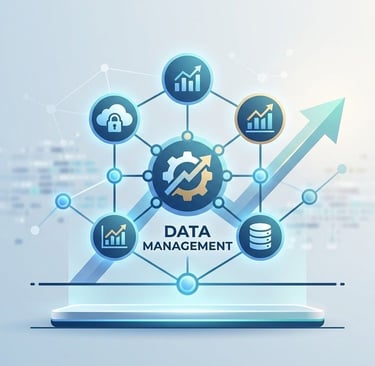
Data management directly affects how efficiently a business operates, how accurately decisions are made, and how quickly teams respond to market changes. Businesses that organize, secure, and analyze operational data consistently experience better forecasting, fewer workflow disruptions, and stronger customer retention. Poor data practices lead to duplicated records, reporting errors, delayed responses, and compliance risks that slow growth.
RD Global Business Solution works with businesses handling customer records, operational workflows, technical support data, and remote workforce coordination. Across these environments, structured data systems repeatedly improve reporting accuracy, communication flow, and operational continuity. This article explains the practical role of data management in business growth, the systems involved, and the factors decision-makers should evaluate before implementing long-term data strategies.
How Data Management Supports Business Expansion
Business growth creates larger volumes of customer information, employee records, support tickets, invoices, and operational reports. Without structured data handling, information becomes fragmented across departments.
Effective data management improves:
Decision-making speed
Reporting accuracy
Customer service consistency
Operational scalability
Regulatory compliance
Cross-department collaboration
According to IBM, poor data quality costs organizations trillions annually through inefficiencies and operational losses. Similarly, research from Gartner shows that businesses increasingly prioritize data governance because unreliable information affects forecasting and customer experience.
Operational Areas Most Affected by Data Quality
Customer Support
Impact of Strong Data Management: Faster ticket resolution
Risk of Poor Data Handling: Repeated customer issues
Workforce Management
Impact of Strong Data Management: Accurate employee records
Risk of Poor Data Handling: Payroll and scheduling errors
IT Operations
Impact of Strong Data Management: Reduced downtime tracking gaps
Risk of Poor Data Handling: Delayed incident response
Sales Reporting
Impact of Strong Data Management: Reliable forecasting
Risk of Poor Data Handling: Misaligned growth planning
Compliance Documentation
Impact of Strong Data Management: Easier audits and verification
Risk of Poor Data Handling: Regulatory exposure
Core Components of Effective Data Management
Businesses often assume data management only involves storage. In practice, it includes governance, accessibility, accuracy, security, and lifecycle monitoring.
Data Collection Standards
Organizations need standardized formats for collecting information across departments. Consistent naming conventions and validation rules reduce duplication.
Bonus Tip: Businesses integrating customer support and workforce systems should align record fields early. Mismatched data structures often create reporting gaps later.
Centralized Data Storage
Centralized systems improve accessibility and reduce version conflicts. Cloud-based platforms are commonly used because they support remote collaboration and automated backups.
Data Security and Access Control
Businesses handling customer records or remote support operations must define user permissions clearly. Access segmentation minimizes accidental deletion and unauthorized changes.
According to Statista, global cybercrime costs continue rising annually, making secure data practices a core operational requirement rather than an optional upgrade.
Data Backup and Recovery
Backup strategies protect operational continuity during outages, cyber incidents, or hardware failures.
Automated Backups
Business Benefit: Faster recovery
Operational Purpose: Prevents permanent data loss
Multi-location Storage
Business Benefit: Reduced downtime risk
Operational Purpose: Improves disaster recovery
Access Logs
Business Benefit: Activity tracking
Operational Purpose: Supports accountability
Encryption
Business Benefit: Stronger data protection
Operational Purpose: Protects sensitive information
Version Control
Business Benefit: Easier rollback management
Operational Purpose: Prevents accidental overwrite
Common Data Management Challenges Businesses Face
Many businesses experience growth before building structured information systems. This creates operational strain over time.
Fragmented Systems
Different departments often use disconnected tools that cannot communicate effectively. This creates duplicate records and inconsistent reporting.
Inaccurate Reporting
Outdated spreadsheets and manual entry processes increase human error. Decision-makers then rely on incomplete information.
Scaling Problems
Systems that work for small teams may fail during expansion. Increased customer interactions, remote workforce growth, and support ticket volume demand scalable infrastructure.
Compliance Pressure
Industries managing sensitive customer information must maintain documentation standards and retention policies.
Comparing Structured and Unstructured Data Practices
Businesses with Structured Data Processes
Standardized reporting systems
Faster operational decision-making
Easier department collaboration
More reliable customer records
Better audit preparation
Businesses with Unstructured Data Processes
Frequent duplicate entries
Inconsistent reporting
Delayed support responses
Higher administrative workload
Increased operational confusion
Practical Indicators That Data Systems Need Improvement
Businesses often recognize operational symptoms before identifying data management as the underlying issue.
Warning Signs to Monitor
Repeated customer complaints
What It Usually Suggests: Inconsistent record management
Conflicting internal reports
What It Usually Suggests: Poor synchronization between systems
Long response times
What It Usually Suggests: Disorganized support data
Duplicate employee records
What It Usually Suggests: Weak data validation
Frequent manual corrections
What It Usually Suggests: Lack of automation controls
Bonus Tip: Businesses scaling remote support teams should audit database permissions quarterly. Access structures become outdated quickly during expansion phases.
Important Factors Before Implementing a Data Strategy
What Decision-Makers Should Evaluate First
Businesses should evaluate operational requirements before selecting platforms or workflows.
Key Considerations
Current data volume and projected growth
Remote workforce accessibility needs
Industry compliance obligations
Integration compatibility with existing systems
Internal staff training requirements
Backup and recovery expectations
Organizations operating across multiple regions should also assess local data protection regulations and cloud storage jurisdiction requirements.
Bonus Tip: Many businesses overcomplicate early-stage systems. A simplified structure with strong consistency usually performs better than fragmented advanced tools.
Relevant Operational Support Services
Business Support Services Aligned With Data Management
Virtual Office Setup
Supports centralized communication and document coordination for distributed teams.Helps businesses organize recruitment workflows, candidate records, onboarding documentation, and workforce planning data
IT & Tech Support
Assists with infrastructure monitoring, system troubleshooting, and operational continuity.Customer Support
Improves ticket tracking, response consistency, and customer interaction documentation.Data Management
Focuses on organizing, securing, maintaining, and optimizing operational information systems.
Questions Businesses Commonly Ask Before Improving Data Systems
How often should business data be audited?
Most operational systems benefit from quarterly reviews. High-volume customer support environments may require monthly validation checks.
Should smaller businesses invest in centralized systems early?
Early implementation reduces migration complexity later. Businesses usually face higher operational disruption when restructuring data systems after rapid expansion.
What departments benefit first from better data management?
Customer support, operations, and workforce coordination teams usually experience immediate improvements because they rely heavily on accurate real-time information.
Long-Term Questions Businesses Continue to Ask
How does data management improve customer retention?
Accurate records reduce response delays, improve personalization, and prevent repeated customer issues.
Can poor data management affect scalability?
Yes. Expansion becomes slower when teams cannot access reliable operational information quickly.
What is the difference between data storage and data governance?
Storage focuses on where information exists. Governance defines how information is organized, protected, accessed, and maintained.
How can businesses reduce duplicate records?
Standardized entry rules, automated validation systems, and centralized databases significantly reduce duplication.
Does remote work increase data management risks?
Remote operations increase access complexity and require stronger permission controls, monitoring systems, and secure collaboration platforms.
Conclusion
Data management affects every operational layer of a growing business. Accurate information improves planning, strengthens customer service, supports workforce coordination, and reduces operational inefficiencies. Businesses that build structured systems early typically adapt faster during expansion and experience fewer reporting disruptions.
Decision-makers should evaluate scalability, security, integration capability, and operational simplicity before implementing long-term data strategies. Consistency, accessibility, and governance remain more important than system complexity.
Discuss Operational Data Needs With Experienced Teams
Businesses evaluating workflow efficiency, remote operations, customer support coordination, or centralized information systems can consult RD Global Business Solution for operational guidance related to data management and technical support environments. For further discussion, contact RD Global Business Solution at info@rdglobalbizsol.com or call +971 56 624 9846 to review business-specific operational requirements.
Empowering your business with operational excellence solutions.
Al Moosa tower - 810 - 1 Sheikh Zayed Rd - Dubai








Solutions
Company
Contact
© 2026 RD Global Solutions. All Rights Reserved.


+971 56 624 9846

info@rdglobalbizsol.com