
How to Choose the Right Offshore Service Provider?
Learn how to evaluate offshore service providers based on expertise, security, scalability, and transparency for long-term success.
6/5/20264 min read

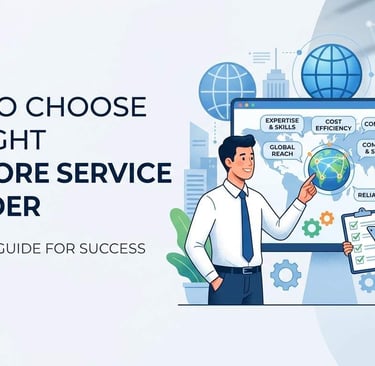
Selecting the right offshore service provider depends on four critical factors: proven expertise, operational transparency, data security standards, and the ability to scale services as business needs evolve. A provider should demonstrate consistent service delivery, clear communication processes, and measurable performance outcomes rather than relying on broad claims.
Organizations that choose offshore partners based solely on short-term convenience often encounter challenges related to quality control, compliance, and operational alignment. This guide explains the key evaluation criteria, common decision-making mistakes, and practical assessment methods used by experienced business leaders when selecting an offshore service provider.
Why Provider Selection Matters?
Offshore partnerships directly affect business continuity, customer experience, operational efficiency, and information security. A reliable provider functions as an extension of internal operations, while an unsuitable provider can create communication gaps, compliance risks, and workflow disruptions.
According to the International Data Corporation (IDC), global spending on outsourced business services continues to grow as organizations seek specialized expertise and operational flexibility. Similarly, research from Deloitte's Global Outsourcing Survey indicates that organizations increasingly prioritize quality, agility, and risk management over simple cost reduction when selecting offshore partners.
Evaluate Core Capabilities Before Making Comparisons
Assess Industry Experience
Industry-specific experience reduces onboarding time and improves operational accuracy. Providers familiar with sector-specific regulations, workflows, and customer expectations can deliver results more consistently.
A practical review should include:
Relevant project experience
Client retention history
Operational processes
Team qualifications
Service-level management procedures
Examine Communication Standards
Communication quality often determines the success of offshore relationships.
Evaluate:
Response time commitments
Reporting frequency
Escalation procedures
Dedicated account management
Collaboration tools used
Bonus Tip: Request sample reports before signing any agreement. Reporting quality often reflects overall operational maturity.
Key Evaluation Criteria for Offshore Service Providers
Industry Expertise
Review similar projects and case studies.
Helps improve operational efficiency and reduce onboarding challenges.
Security Standards
Examine data protection policies and certifications.
Reduces compliance and information security risks.
Communication Processes
Assess reporting structures and response protocols.
Ensures transparency and accountability.
Scalability
Review resource expansion capabilities.
Supports future business growth and changing requirements.
Technology Infrastructure
Evaluate software systems, tools, and backup environments.
Improves service reliability and operational continuity.
Quality Assurance
Review performance monitoring and quality control procedures.
Maintains consistent service standards.
Business Continuity Planning
Assess disaster recovery and contingency plans.
Minimizes disruptions during unexpected events.
Compare Offshore Providers Using Objective Benchmarks
Organizations frequently compare providers based on subjective impressions. A structured evaluation framework produces more reliable results.
Comparing Common Offshore Provider Characteristics
Established Providers
Extensive service offerings.
High scalability.
Broad industry experience.
Mature operational processes.
Significant technology investment.
Moderate operational flexibility.
Growing Providers
Moderate service breadth.
Medium scalability.
Developing industry expertise.
Moderate process maturity.
Greater flexibility in adapting to client requirements.
Moderate technology investment.
Specialized Providers
Focused service offerings.
Scalability varies by niche.
Deep expertise in specific industries or functions.
Strong processes within their area of specialization.
High operational flexibility.
Technology investments targeted toward specialized needs.
Bonus Tip: Prioritize process maturity over company size. Smaller providers with strong systems often outperform larger providers with inconsistent workflows.
Review Security and Compliance Requirements
Data protection has become a primary selection criterion for offshore partnerships. Security assessments should extend beyond marketing claims and focus on verifiable controls.
Important Security Indicators
Data Access Controls
User permissions.
Authentication and authorization procedures.
Backup Procedures
Backup frequency.
Recovery testing practices.
Employee Screening
Recruitment verification standards.
Background checking procedures.
Compliance Frameworks
Relevant regulatory and industry compliance requirements.
Incident Response Plans
Security breach detection and response processes.
Confidentiality Measures
Contractual protections.
Internal information handling procedures.
According to IBM's annual Cost of a Data Breach research, strong security governance significantly reduces operational disruption and incident-related costs, reinforcing the importance of provider due diligence.
Understand Service Scalability and Operational Stability
Business requirements rarely remain static. Offshore providers should support expansion without sacrificing quality.
Questions worth asking include:
How are additional resources deployed?
What is the average onboarding timeline?
How is service quality maintained during rapid growth?
What contingency plans exist for staffing changes?
How are performance metrics monitored?
Providers with documented workforce planning and operational continuity frameworks generally deliver more consistent outcomes during growth periods.
Factors Worth Reviewing Before Finalizing a Provider
Organizational Alignment
The provider's operating model should support business objectives, workflows, and performance expectations.
Consider:
Cultural compatibility
Decision-making structure
Reporting preferences
Time zone coverage
Long-term partnership potential
Contract Clarity
A well-defined agreement should clearly specify:
Scope of work
Performance expectations
Security obligations
Reporting requirements
Exit procedures
Bonus Tip: Review termination and transition clauses carefully. Effective transition planning reduces future operational risks.
Services Commonly Used to Support Offshore Operations
From the perspective of RD Global Business Solution, the following services are frequently integrated into offshore business operations:
Workforce Acquisition
Supports the recruitment and onboarding of qualified professionals aligned with operational requirements.Customer Support
Provides structured customer interaction management across multiple communication channels.IT & Tech Support
Assists with technical operations, troubleshooting, infrastructure support, and system maintenance.Data Management
Improves information organization, accuracy, accessibility, and operational reporting processes.
Questions Decision-Makers Often Ask Before Choosing
How many providers should be evaluated?
Reviewing at least three qualified providers allows for meaningful comparisons of capabilities, processes, and operational fit.
Should specialization outweigh service variety?
When operational requirements are highly specific, specialized expertise often delivers stronger outcomes than broad service offerings.
Is a pilot project necessary?
Pilot engagements provide practical insight into communication quality, service consistency, and operational compatibility.
How important are client references?
References help validate service quality, responsiveness, and long-term reliability beyond marketing materials.
Answers to Long-Term Questions After Partner Selection
How often should provider performance be reviewed?
Formal performance evaluations should occur quarterly, supported by ongoing operational monitoring.
What metrics are most useful for measuring success?
Service accuracy, response times, quality indicators, productivity metrics, and stakeholder satisfaction provide valuable insights.
How can offshore relationships remain effective over time?
Consistent communication, documented processes, and clearly defined expectations support long-term success.
When should businesses consider changing providers?
Repeated service failures, security concerns, communication breakdowns, or inability to scale may indicate a need for reassessment.
Can multiple offshore providers be used simultaneously?
Yes. Many organizations use specialized providers for different operational functions to improve flexibility and expertise coverage.
Final Words
The right offshore service provider demonstrates expertise, security, transparency, scalability, and operational consistency. Effective evaluation focuses on measurable capabilities rather than assumptions or short-term considerations. Organizations that conduct structured assessments, verify security standards, and prioritize operational alignment typically achieve stronger long-term outcomes from offshore partnerships.
Discuss Your Offshore Support Requirements
Organizations evaluating offshore operational support can benefit from discussing requirements with experienced professionals before making a final decision. RD Global Business Solution can provide information regarding Workforce Acquisition, Customer Support, IT & Tech Support, and Data Management services. For additional details, contact info@rdglobalbizsol.com or call +971566249846 to discuss operational requirements and determine the most appropriate support structure for specific business objectives.
Empowering your business with operational excellence solutions.
Al Moosa tower - 810 - 1 Sheikh Zayed Rd - Dubai








Solutions
Company
Contact
© 2026 RD Global Solutions. All Rights Reserved.


+971 56 624 9846

info@rdglobalbizsol.com