
Common Myths About Offshore Services (And the Truth Behind Them)
Discover the truth behind common offshore service myths, including quality, communication, security, and scalability concerns.
5/22/20265 min read
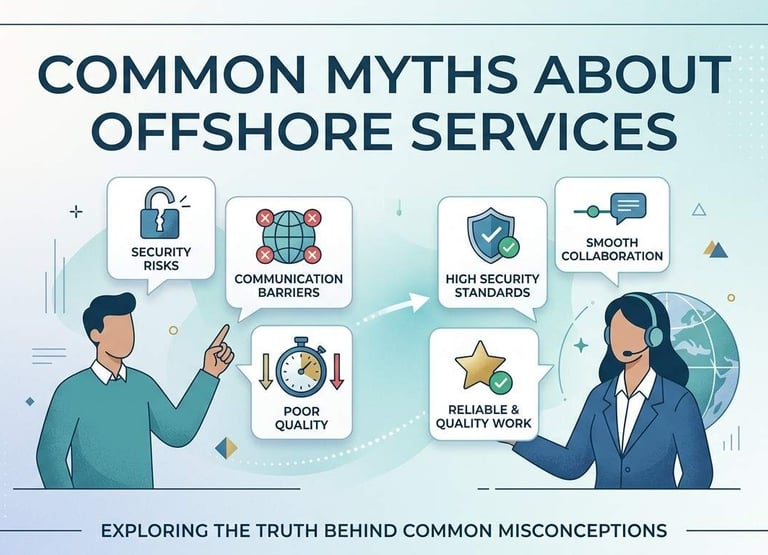
Many businesses still assume offshore services reduce quality, create communication problems, or increase operational risks. In practice, offshore support models have evolved significantly over the last decade. Structured onboarding systems, cloud-based collaboration tools, cybersecurity frameworks, and skilled global workforces now allow offshore teams to operate as direct extensions of in-house departments.
RD Global Business Solution regularly works with organizations that initially hesitate because of outdated assumptions about outsourcing and offshore operations. Most concerns stem from early offshore models that prioritized low costs over operational standards. Current offshore services focus more on process control, workforce specialization, compliance management, and scalable business continuity.
This guide breaks down the most common misconceptions, explains what actually happens in modern offshore operations, and highlights the factors businesses should evaluate before choosing an offshore partner.
Why Offshore Services Continue to Grow Globally?
Offshore business services are no longer limited to large corporations. Small and mid-sized businesses increasingly use offshore support for customer operations, technical assistance, administrative management, and workforce scaling.
According to Statista, the global business process outsourcing market continues to expand steadily due to increased demand for remote operational support and digital workforce solutions. Meanwhile, Deloitte reports that operational flexibility and access to specialized talent now rank higher than cost reduction when companies outsource services.
Key operational drivers behind offshore growth
Faster workforce scaling during business expansion
Access to multilingual and specialized professionals
Extended customer support coverage across time zones
Reduced administrative workload for internal teams
Improved continuity during regional disruptions
Common Offshore Service Myths And What Actually Happens
Myth 1: Offshore services always reduce quality
Quality problems usually come from weak onboarding, unclear processes, or poor vendor management rather than geography itself.
Modern offshore providers rely heavily on:
SOP-driven workflows
KPI tracking systems
QA audits
CRM integrations
Real-time reporting dashboards
Many offshore support teams now follow the same operational frameworks used by internal departments.
Myth 2: Communication barriers make collaboration difficult
This assumption was more common before cloud collaboration tools became standard.
Today, offshore teams routinely use:
Slack and Microsoft Teams help teams manage daily communication, coordinate tasks, and share operational updates between offshore and in-house staff.
Zoom and Google Meet support virtual meetings, onboarding sessions, workflow discussions, and employee training.
Shared CRMs allow teams to monitor customer interactions, manage support requests, and maintain consistent service records.
Project management platforms improve workflow visibility, task tracking, accountability, and deadline management across distributed teams.
Businesses that establish response-time expectations and documented workflows usually experience fewer communication issues overall.
Myth 3: Offshore workers lack specialized expertise
Many offshore professionals work in highly technical industries including IT infrastructure, customer experience management, data processing, and software support.
Countries with strong offshore ecosystems often produce large numbers of trained graduates in:
Information technology
Cybersecurity
Customer operations
Administrative management
Data analytics
According to the World Economic Forum, remote digital workforces are becoming central to global business operations because talent availability increasingly matters more than physical location.
Myth 4: Offshore operations create major security risks
Security risks exist in every operational model, including internal teams. The difference lies in how access controls and compliance systems are managed.
Modern offshore providers typically implement:
VPN-restricted access protects internal systems by limiting network access to authorized users only.
Multi-factor authentication helps prevent unauthorized access by requiring additional identity verification steps.
Role-based permissions reduce unnecessary data exposure by limiting employee access based on operational responsibilities.
Activity monitoring systems track operational behavior, login activity, and system usage to improve oversight and security control.
Confidentiality agreements establish legal accountability and define responsibilities related to sensitive business information
Businesses operating in finance, healthcare, or regulated industries should still verify compliance requirements before outsourcing sensitive functions.
Bonus Tip
Operational transparency matters more than location. Businesses should request workflow documentation, reporting examples, escalation procedures, and communication structures before signing agreements.
How Offshore Services Actually Function Day To Day?
Successful offshore operations rarely operate independently from the business. Instead, they integrate into existing systems and processes.
A typical offshore workflow often includes:
Process mapping and role definition
Knowledge transfer and onboarding
Workflow documentation
Pilot-phase testing
Performance monitoring
Continuous reporting and optimization
The most effective offshore partnerships focus on measurable outcomes rather than task volume alone.
Offshore Models Compared By Operational Structure
Dedicated Team Model
Best suited for long-term operational support. This model allows offshore teams to integrate fully with internal business processes, communication systems, and workflow management structures.Project-Based Support
Ideal for short-term specialized tasks with clearly defined timelines, deliverables, and operational objectives. Businesses often use this model for temporary projects or technical implementations.Hybrid Workforce Model
Works well for growing businesses that need a combination of in-house staff and offshore operational support. This structure improves scalability while maintaining internal oversight.Shared Resource Model
Designed for smaller operational workloads where businesses require flexible support without assigning full-time dedicated teams. Resources are allocated based on current operational demand.
Each structure carries different management requirements, communication expectations, and scalability advantages.
Important Factors Before Choosing Offshore Support
Businesses often focus heavily on staffing numbers while ignoring operational compatibility. The better approach involves evaluating long-term workflow alignment.
Areas that require careful evaluation
Industry-specific experience
Time zone overlap
Communication procedures
Security policies
Reporting transparency
Escalation handling
Staff retention stability
Technology compatibility
Bonus Tip
Request a small pilot project before committing to full operational migration. Pilot phases expose workflow gaps early and reduce long-term disruption risks.
Operational Services That Commonly Support Offshore Strategies
Workforce Acquisition
RD Global Business Solution helps businesses identify operational talent for customer support, administrative functions, and technical support roles while maintaining structured onboarding processes.
Customer Support
Customer service teams assist businesses that require scalable communication handling, ticket management, and multi-channel support coverage across extended hours.
IT & Tech Support
Technical support services help businesses maintain system monitoring, troubleshooting assistance, and operational continuity for digital infrastructure.
Data Management
Data processing and administrative management services support document handling, structured reporting, and operational database organization.
Questions Businesses Usually Ask Before Outsourcing
How quickly can offshore teams integrate into existing systems?
Integration speed depends on documentation quality, training structure, and workflow complexity. Most operational teams require a structured onboarding period before reaching full efficiency.
Which business functions are usually outsourced first?
Customer support, administrative processing, technical assistance, and data management are among the most commonly outsourced functions because they scale effectively.
Does offshore support replace internal employees?
Most businesses use offshore teams to extend operational capacity rather than fully replace internal departments.
What Businesses Often Want To Know Later
How can offshore team performance be measured effectively?
Use measurable KPIs such as response times, ticket resolution rates, customer satisfaction scores, workflow completion speed, and reporting accuracy.
What causes most offshore project failures?
Poor communication structures, unclear responsibilities, and missing process documentation are among the most common causes.
Should businesses assign internal managers to offshore teams?
Yes. Internal oversight improves alignment, accountability, and workflow consistency across departments.
Can offshore support scale during seasonal demand increases?
Most offshore models are designed specifically for scalable workforce adjustments during operational fluctuations.
How often should offshore processes be reviewed?
Quarterly operational reviews help identify workflow inefficiencies, training needs, and performance improvement opportunities.
Final Words
Offshore services are no longer defined by outdated assumptions about low-quality support or disconnected teams. Modern offshore operations rely on structured systems, measurable workflows, cybersecurity standards, and specialized talent pools that integrate directly into business operations.
The most successful offshore partnerships begin with realistic expectations, documented processes, and clear operational accountability. Businesses should evaluate compatibility, communication systems, security standards, and long-term scalability before making decisions.
Speak With RD Global Business Solution
Businesses exploring offshore operational support often benefit from discussing workflow structure, communication expectations, and scalability planning before making decisions. RD Global Business Solution provides guidance across workforce acquisition, customer support, IT support, and data management operations.
For operational inquiries or service discussions, contact RD Global Business Solution at info@rdglobalbizsol.com or call +971566249846.
Empowering your business with operational excellence solutions.
Al Moosa tower - 810 - 1 Sheikh Zayed Rd - Dubai







Solutions
Company
Contact
© 2026 RD Global Solutions. All Rights Reserved.


+971 56 624 9846

info@rdglobalbizsol.com