
How to Build a Remote Team Without Hiring In-House Staff?
Learn how to build a remote team without hiring in-house staff using structured workflows, KPIs, outsourcing, and scalable systems.
5/25/20264 min read
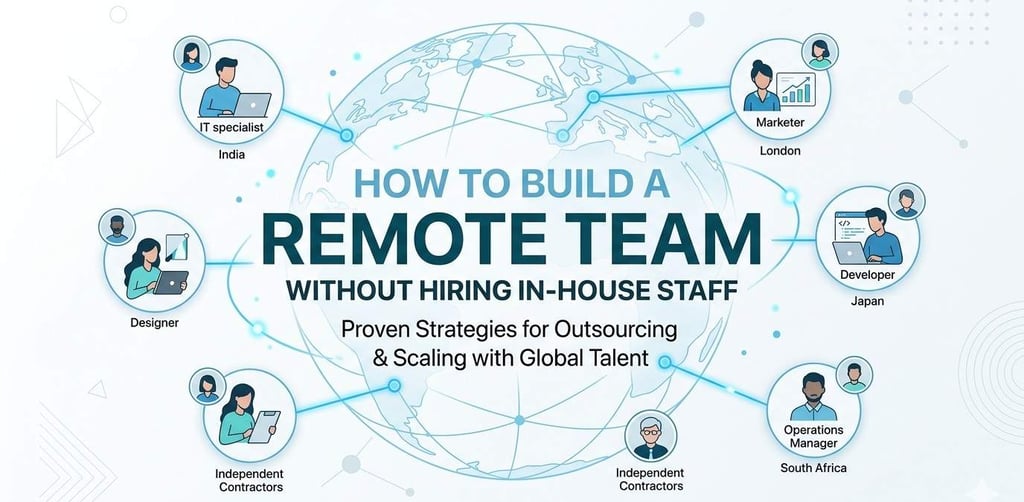
Building a remote team without hiring in-house staff requires a structured outsourcing model, clear communication systems, and role-based workforce planning. Businesses reduce operational overhead, access global talent faster, and maintain flexibility by using remote specialists instead of maintaining physical office teams. The process works best when responsibilities, workflows, reporting structures, and data access policies are defined before onboarding begins.
Many businesses struggle with remote workforce management because they treat external teams like temporary freelancers instead of integrating them into daily operations. Experienced workforce providers consistently see stronger results when remote staff receive documented procedures, measurable KPIs, and centralized communication channels from the start. This guide explains how to structure a scalable remote team while maintaining accountability, productivity, and operational consistency.
[Image: Remote professionals collaborating through virtual work systems]
Build the Right Remote Team Structure First
A remote team performs effectively when each role supports a clearly defined business function. Hiring without operational planning often creates communication gaps and duplicated tasks.
Choose Roles Based on Business Outcomes
Start with outcomes instead of job titles. Identify which operations consume the most time internally and determine whether those functions can be handled remotely.
Customer Communication
Suitable Remote Role: Customer support specialist
Key Responsibility: Handle inquiries and ticket resolution
Best Use Case: Service-based businesses
Administrative Work
Suitable Remote Role: Virtual assistant
Key Responsibility: Scheduling, reporting, and coordination
Best Use Case: Growing startups
Technical Operations
Suitable Remote Role: IT support specialist
Key Responsibility: System maintenance and troubleshooting
Best Use Case: Digital businesses
Data Handling
Suitable Remote Role: Data management executive
Key Responsibility: Data entry, validation, and reporting
Best Use Case: High-volume operations
Recruitment Support
Suitable Remote Role: Workforce acquisition coordinator
Key Responsibility: Candidate sourcing and onboarding
Best Use Case: Scaling companies
Decide Between Dedicated and Shared Teams
Different remote structures fit different operational goals.
Dedicated Remote Team
Operational Advantage: High consistency and strong process familiarity
Limitation: Requires long-term planning
Suitable For: Ongoing operations
Project-Based Staffing
Operational Advantage: Flexible workload handling
Limitation: Limited continuity
Suitable For: Temporary projects
Hybrid Workforce Model
Operational Advantage: Combines internal oversight with remote execution
Limitation: Requires stronger coordination
Suitable For: Expanding businesses
Shared Support Model
Operational Advantage: Efficient for repetitive tasks
Limitation: Less process customization
Suitable For: Small businesses
According to a 2024 report by Gallup, organizations with clearly structured remote collaboration systems report stronger employee engagement and operational efficiency than businesses using unstructured remote workflows.
Create Standardized Communication Systems
Communication failures remain one of the largest causes of remote workforce inefficiency. Structured communication reduces delays and improves accountability.
Use One Primary Communication Channel
Avoid spreading communication across multiple disconnected platforms. Assign a single primary channel for operational updates.
Daily Updates
Recommended System Type: Team collaboration platform
Operational Benefit: Faster visibility
Task Tracking
Recommended System Type: Project management software
Operational Benefit: Deadline accountability
File Access
Recommended System Type: Cloud document storage
Operational Benefit: Version control
Escalation Handling
Recommended System Type: Dedicated support channel
Operational Benefit: Faster issue resolution
Bonus Tip: Businesses managing remote teams across UAE and South Asian time zones often improve response times by overlapping at least two working hours between departments.
Document Processes Before Onboarding
Remote staff depend heavily on written systems because direct supervision is limited.
Create documentation for:
Reporting procedures
Escalation workflows
Access permissions
Task completion standards
Client communication protocols
A 2025 workplace operations study from McKinsey & Company found that businesses with standardized digital workflows reduce operational delays significantly compared to companies relying on informal instructions.
Protect Operational Security and Data Access
Remote operations increase exposure to data risks if permissions are unmanaged.
Implement Controlled Access Systems
File Access
Recommended Practice: Role-based permissions
Operational Impact: Prevents unauthorized visibility
Password Management
Recommended Practice: Centralized password tools
Operational Impact: Improves account security
Device Usage
Recommended Practice: Company-approved systems
Operational Impact: Reduces security vulnerabilities
Client Information
Recommended Practice: Restricted data segmentation
Operational Impact: Protects confidential records
Businesses handling customer data across multiple regions should also align remote workflows with regional compliance requirements and internal data retention policies.
[Image: Business manager reviewing remote workforce performance dashboards]
Maintain Performance Without Micromanagement
High-performing remote teams rely on measurable outcomes instead of constant supervision.
Track Productivity Through KPIs
Use measurable indicators tied directly to business goals.
Customer Support
Useful KPI: First response time
Why It Matters: Measures service efficiency
Data Management
Useful KPI: Error reduction rate
Why It Matters: Tracks accuracy
IT Support
Useful KPI: Resolution turnaround
Why It Matters: Evaluates technical responsiveness
Workforce Acquisition
Useful KPI: Time-to-fill roles
Why It Matters: Measures recruitment speed
Bonus Tip: Weekly performance reviews often work better than daily monitoring because they encourage accountability without disrupting workflow concentration.
Remote Workforce Services That Support Scalable Operations
RD Global Business Solution supports businesses building structured remote operations through operational workforce services aligned with long-term scalability.
Virtual Office Setup
Establishes centralized business coordination systems for remote operational management.Workforce Acquisition
Supports remote staff sourcing, onboarding coordination, and workforce alignment.Customer Support
Provides structured customer communication support for service continuity.IT & Tech Support
Assists businesses with remote infrastructure stability and technical issue management.
Evaluate Operational Readiness Before Expanding
Before scaling a remote workforce, evaluate whether internal systems can support distributed operations efficiently.
Important Factors Before Choosing a Remote Team Model
Workflow Clarity
Key Question: Are procedures documented?
Why It Matters: Prevents operational confusion
Communication
Key Question: Is there a centralized reporting system?
Why It Matters: Improves accountability
Data Security
Key Question: Are access permissions controlled?
Why It Matters: Reduces operational risk
Scalability
Key Question: Can systems support additional staff later?
Why It Matters: Avoids restructuring
Oversight
Key Question: Are KPIs measurable?
Why It Matters: Maintains productivity standards
Businesses operating across the UAE often require additional coordination planning due to cross-border staffing structures, multilingual communication requirements, and varying business-hour overlaps.
Questions Businesses Ask Before Building Remote Teams
How many remote staff should a business hire initially?
Most businesses start with one operational department such as customer support or administration before expanding into technical and data-related functions.
Should remote workers follow local business hours?
Operational overlap matters more than identical schedules. Teams usually perform better when at least part of the workday aligns with management hours.
Is outsourcing better than freelance hiring?
Structured outsourcing models typically provide better continuity, accountability, and replacement support compared to managing multiple freelancers independently.
Long-Term Remote Team Management Questions
How can remote teams maintain company culture?
Consistent communication, shared operational goals, and documented standards help remote staff stay aligned with business expectations.
What causes remote team turnover most often?
Unclear expectations, inconsistent management, and limited workflow structure contribute heavily to remote staff instability.
How often should remote workflows be reviewed?
Quarterly operational reviews help identify inefficiencies, communication delays, and resource gaps before they affect productivity.
Can remote teams handle sensitive customer information?
Yes, when businesses implement role-based access systems, encrypted storage tools, and documented security procedures.
What makes remote operations scalable?
Scalability depends on standardized workflows, measurable KPIs, centralized systems, and structured onboarding processes.
Final Words
Building a remote team without hiring in-house staff depends on operational structure more than workforce size. Businesses achieve stronger long-term performance when remote roles align with measurable objectives, communication systems remain centralized, and onboarding procedures stay standardized. Sustainable remote operations prioritize accountability, documentation, and controlled scalability instead of rapid hiring.
Discuss Remote Workforce Planning With Experienced Operational Support
RD Global Business Solution provides operational guidance for businesses building structured remote workforce systems across customer support, workforce acquisition, virtual office coordination, and technical support environments. Businesses seeking operational clarity can contact RD Global Business Solution at info@rdglobalbizsol.com or call +971566249846 for further workforce coordination information.
Empowering your business with operational excellence solutions.
Al Moosa tower - 810 - 1 Sheikh Zayed Rd - Dubai








Solutions
Company
Contact
© 2026 RD Global Solutions. All Rights Reserved.


+971 56 624 9846

info@rdglobalbizsol.com