
BPO vs In-House Support: What’s Right for You?
Compare BPO vs in-house support to find the best model for your business. Learn key differences, benefits, and how to choose the right approach today guide
6/4/20265 min read
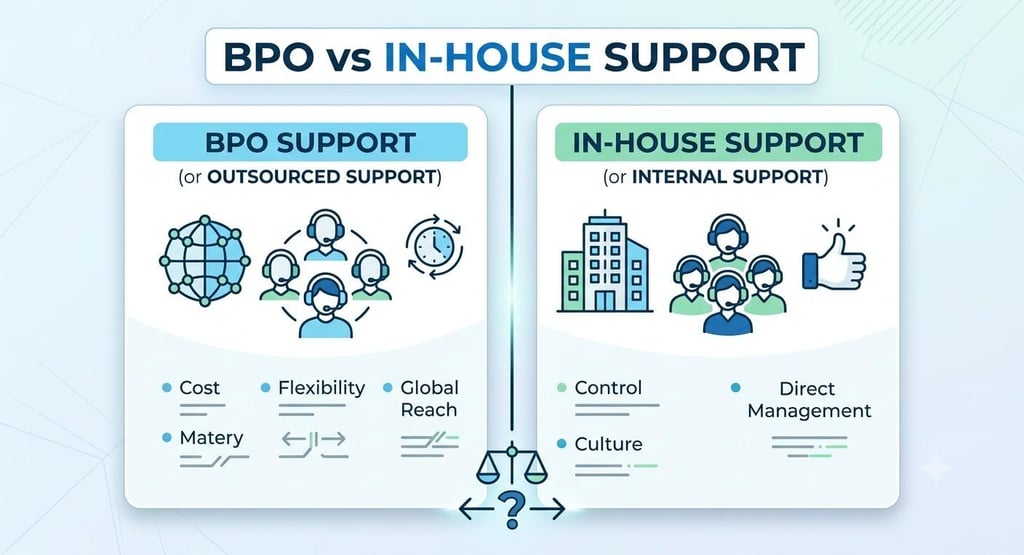
Choosing between Business Process Outsourcing (BPO) and in-house support depends on operational goals, scalability requirements, internal expertise, and the level of control needed over customer interactions. Neither option is universally better. The right choice depends on business size, growth stage, customer expectations, and resource availability.
Organizations that need rapid scalability and specialized expertise often benefit from outsourced support models, while businesses that require complete operational control and deep product knowledge may prefer in-house teams. Based on practical experience across customer service operations, workforce management, and support infrastructure, the most successful decisions come from aligning support strategy with long-term business objectives rather than following industry trends.
This guide explains the key differences, operational considerations, and decision-making factors to help determine which support model best fits specific business needs.
[Image: Customer support team comparing outsourced and in-house service models]
Understanding the Two Support Models
What Is In-House Support
In-house support refers to customer service operations managed entirely by internal employees. Recruitment, training, performance management, technology infrastructure, and quality assurance remain under direct organizational control.
This model provides greater visibility into daily operations and allows support teams to develop deep familiarity with products, services, and company culture.
What Is BPO Support
BPO support involves outsourcing customer service functions to specialized third-party providers. These providers manage staffing, training, operational processes, and service delivery according to agreed performance standards.
BPO partners typically offer multilingual support, extended service hours, and established operational frameworks that reduce management complexity.
How BPO and In-House Support Compare in Real Operations?
Scalability
BPO Support: Rapid expansion during demand fluctuations.
In-House Support: Expansion depends on hiring cycles.
Recruitment Responsibility
BPO Support: Managed by the service provider.
In-House Support: Managed internally.
Training Resources
BPO Support: Established training programs are already available.
In-House Support: Customized training developed internally.
Operational Control
BPO Support: Shared oversight between the business and provider.
In-House Support: Complete internal control.
Knowledge Retention
BPO Support: Depends on provider documentation and processes.
In-House Support: Knowledge remains within the organization.
Technology Management
BPO Support: Often included within the provider's service model.
In-House Support: Managed internally.
Global Coverage
BPO Support: Easier to implement across regions and time zones.
In-House Support: Requires additional infrastructure and staffing.
Business Flexibility
BPO Support: Highly adaptable for growth and changing demand.
In-House Support: Better suited for specialized operations.
Management Workload
BPO Support: Reduced administrative burden.
In-House Support: Greater management involvement required.
Service Consistency
BPO Support: Dependent on provider governance and processes.
In-House Support: Directly monitored and controlled internally.
Bonus Tip: Organizations experiencing seasonal demand spikes often achieve smoother service continuity by using outsourced support for variable workloads while maintaining core functions internally.
Key Performance Factors That Influence the Decision
Workforce Availability
According to research from Deloitte, access to talent and operational flexibility remain among the leading reasons organizations outsource business functions.
Support operations frequently face challenges such as employee turnover, recruitment delays, and training bottlenecks. BPO providers generally maintain larger talent pools that help address these challenges more efficiently.
Customer Experience Expectations
Customer expectations continue to rise. Data from Microsoft Customer Service Research shows that consumers increasingly value fast response times and consistent service across communication channels.
Businesses serving complex products or highly technical services often benefit from internal teams that possess deeper organizational knowledge.
Scalability and Business Growth
Research from Statista indicates continued global growth in outsourcing services, driven largely by organizations seeking operational flexibility and access to specialized expertise.
Businesses entering new markets, expanding internationally, or launching new service lines often require support structures that can scale quickly without disrupting service quality.
Technical Characteristics of Each Support Model
Workforce Management
BPO Environment: Provider-managed staffing and scheduling.
In-House Environment: Internal HR and management teams oversee staffing.
Quality Monitoring
BPO Environment: Shared reporting and oversight.
In-House Environment: Direct supervision and quality control.
Technology Infrastructure
BPO Environment: Often supplied and maintained by the provider.
In-House Environment: Owned and maintained internally.
Security Governance
BPO Environment: Managed through contractual compliance standards.
In-House Environment: Governed through internal policies and procedures.
Knowledge Management
BPO Environment: Shared documentation and knowledge systems.
In-House Environment: Internal knowledge repositories and resources.
Business Continuity Planning
BPO Environment: Supported through provider contingency frameworks.
In-House Environment: Managed through internal continuity strategies.
Reporting Structure
BPO Environment: Guided by service-level agreements and performance metrics.
In-House Environment: Managed through direct reporting channels.
Situations Where Each Option Performs Best
When BPO Support Often Delivers Better Results
Rapid business growth
Multi-language customer support requirements
Extended operating hours
Seasonal workload fluctuations
Limited internal support infrastructure
When In-House Support Often Delivers Better Results
Highly specialized products
Complex technical environments
Strict regulatory requirements
Strong emphasis on organizational culture
Long-term customer relationship management
Bonus Tip: Many mature organizations adopt a hybrid model. Core customer interactions remain internal while routine inquiries are handled through outsourced teams.
[Image: Hybrid customer support structure combining internal and outsourced teams]
Important Factors to Evaluate Before Choosing
Before selecting either model, decision-makers should assess the following areas carefully:
Business Growth Plans
Determine whether support demand is expected to increase significantly over the next 12–24 months.
Customer Complexity
Assess whether customers require specialized product or service knowledge.
Management Capacity
Evaluate whether leadership can effectively manage and oversee a support department.
Service Hours
Consider whether extended or around-the-clock support coverage is necessary.
Compliance Requirements
Review industry regulations and customer data protection obligations.
Workforce Availability
Determine whether qualified support professionals are readily available.
Technology Readiness
Assess whether existing systems can support future operational growth and service demands.
Support Services That Help Build Effective Customer Operations
RD Global Business Solution supports organizations seeking operational efficiency through the following relevant services:
Customer Support
Structured customer service solutions designed to improve responsiveness and service consistency.Workforce Acquisition
Assistance with sourcing and building skilled teams aligned with operational requirements.IT & Tech Support
Technical infrastructure support that helps maintain stable customer service operations.Data Management
Organized information systems that improve reporting accuracy, compliance, and decision-making.
Questions Decision-Makers Frequently Ask Before Choosing
Should growing companies outsource customer support immediately?
Not necessarily. Growth stage, service complexity, and internal management capabilities should determine the approach.
Can outsourced teams maintain service quality?
Yes, provided performance standards, reporting processes, and quality monitoring systems are clearly defined.
Is a hybrid support model effective?
For many organizations, hybrid structures provide a balance between scalability and operational control.
How important is internal expertise?
The more specialized the product or service, the more valuable internal expertise becomes.
Long-Term Questions About Support Operations
How often should support models be reviewed?
Operational requirements should be reassessed annually or whenever significant business changes occur.
What metrics matter most when evaluating support performance?
Customer satisfaction, response time, resolution rate, and service consistency typically provide the most useful insights.
Can businesses switch from one model to another later?
Yes. Many organizations transition between outsourced, internal, and hybrid models as operational needs evolve.
How can support quality remain consistent during growth?
Standardized processes, documented workflows, and regular performance reviews help maintain consistency.
What role does technology play in support effectiveness?
Technology improves ticket management, reporting accuracy, customer communication, and workforce productivity.
Final Words
The decision between BPO and in-house support should be based on operational priorities rather than assumptions. Businesses seeking flexibility, scalability, and rapid workforce expansion often benefit from outsourced models. Organizations requiring deep product expertise and direct operational control may find greater value in internal teams.
Carefully evaluate growth plans, customer expectations, workforce availability, and management capacity before making a decision. The most effective support strategy is the one that aligns with long-term business objectives while maintaining a consistent customer experience.
Discuss Your Support Strategy
Organizations evaluating customer support structures can benefit from a detailed assessment of operational requirements, workforce needs, and service expectations. RD Global Business Solution provides guidance across customer support operations, workforce acquisition, technology support, and data management initiatives. For further information, contact info@rdglobalbizsol.com or call +971566249846.
Empowering your business with operational excellence solutions.
Al Moosa tower - 810 - 1 Sheikh Zayed Rd - Dubai








Solutions
Company
Contact
© 2026 RD Global Solutions. All Rights Reserved.


+971 56 624 9846

info@rdglobalbizsol.com