
Is Back Office Outsourcing the Key to Business Growth?
Discover how back office outsourcing improves efficiency, scalability, and productivity while helping businesses focus on growth and core operations.
6/2/20264 min read
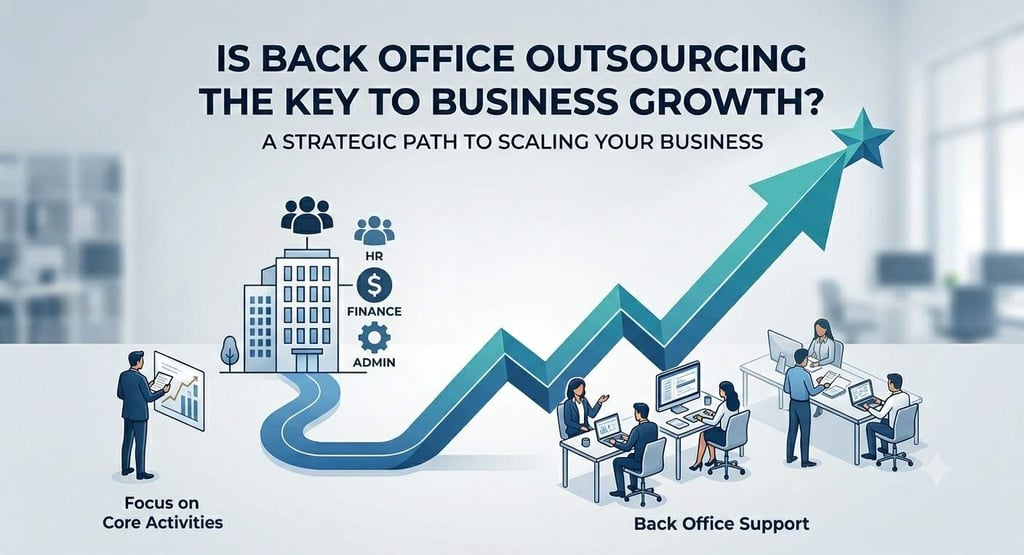
Back office outsourcing helps growing businesses increase operational capacity without overloading internal teams. By delegating administrative and support functions such as data management, customer support administration, workforce coordination, and technical support processes, businesses can focus more resources on revenue-generating activities, strategic planning, and customer relationships.
Organizations that scale successfully often recognize a common challenge: operational complexity grows faster than revenue. Experience across multiple industries shows that structured back office outsourcing can improve process consistency, reduce administrative bottlenecks, and support business growth without disrupting core operations. This article explains how outsourcing works, where it delivers value, and what decision-makers should evaluate before implementing it.
Why Back Office Outsourcing Supports Business Growth
As organizations expand, administrative workloads increase significantly. Tasks such as documentation, employee coordination, technical support management, customer service administration, and database maintenance require dedicated resources.
Back office outsourcing addresses these challenges by providing:
Improved operational efficiency
Better process standardization
Greater scalability during growth phases
Enhanced focus on core business objectives
Faster adaptation to changing business demands
According to research from Deloitte's Global Outsourcing Survey, organizations frequently identify operational efficiency and access to specialized talent as primary reasons for outsourcing business functions. Similarly, industry analysis from Statista indicates continued growth in the global business process outsourcing market, reflecting widespread adoption among scaling businesses.
Understanding Which Functions Are Commonly Outsourced
Not every business process should be outsourced. The most effective approach involves identifying repetitive, process-driven activities that do not directly contribute to competitive differentiation.
Operational Functions Suitable for Outsourcing
Data Management
Activities: Data entry, validation, reporting, database updates
Business Impact: Improved accuracy and consistency
Customer Support Administration
Activities: Ticket processing, customer inquiries, escalation management
Business Impact: Better customer experience
Workforce Acquisition Support
Activities: Candidate screening, scheduling, onboarding coordination
Business Impact: Faster hiring processes
IT & Tech Support Operations
Activities: Helpdesk support, monitoring, issue tracking
Business Impact: Reduced downtime
Administrative Processing
Activities: Documentation, record maintenance, workflow management
Business Impact: Increased productivity
Strategic Planning
Reason: Requires direct leadership involvement
Product Innovation
Reason: Core competitive advantage
Executive Decision Making
Reason: Business-critical authority
Corporate Governance
Reason: Regulatory and organizational oversight
Bonus Tip
Businesses often achieve better results by outsourcing one process at a time rather than transferring multiple departments simultaneously. This approach allows smoother process integration and easier performance measurement.
Operational Impact of Back Office Outsourcing
Successful outsourcing improves more than workload distribution. It creates process structures that support long-term growth.
Increased Scalability
A growing business may experience sudden increases in customer demand, staffing requirements, or technical support requests. Outsourced teams can often expand support capacity faster than traditional hiring models.
Standardized Process Management
Documented workflows and defined service procedures reduce inconsistencies that commonly emerge during rapid expansion.
Improved Resource Allocation
Internal teams can focus on:
Business development
Customer acquisition
Strategic partnerships
Product improvements
Market expansion
Instead of spending valuable time on administrative tasks.
Key Performance Indicators Used to Evaluate Outsourcing Success
The following operational metrics are commonly used to measure effectiveness.
Customer Support
Measurement Indicator: Response time
Desired Outcome: Faster resolution
Data Management
Measurement Indicator: Error rate
Desired Outcome: Higher accuracy
Workforce Operations
Measurement Indicator: Hiring cycle duration
Desired Outcome: Faster onboarding
IT Support
Measurement Indicator: Ticket resolution time
Desired Outcome: Improved service continuity
Administrative Processes
Measurement Indicator: Task completion rate
Desired Outcome: Greater efficiency
Bonus Tip
Establish baseline performance metrics before outsourcing begins. Comparing future performance against existing benchmarks provides a clearer picture of actual business impact.
Common Challenges and How Businesses Address Them
Outsourcing can create challenges if implementation lacks planning.
Poor Communication
Potential Impact: Delays and misunderstandings
Recommended Solution: Define communication protocols
Unclear Expectations
Potential Impact: Inconsistent outcomes
Recommended Solution: Establish documented procedures
Data Security Concerns
Potential Impact: Compliance risks
Recommended Solution: Implement security standards and audits
Process Misalignment
Potential Impact: Workflow disruption
Recommended Solution: Create detailed transition plans
Limited Performance Visibility
Potential Impact: Difficult quality control
Recommended Solution: Use measurable KPIs and reporting
Evaluating Critical Factors Before Choosing an Outsourcing Strategy
Before selecting an outsourcing model, decision-makers should assess several operational factors.
Business Growth Objectives
Determine whether outsourcing supports expansion goals, operational efficiency targets, or both.
Process Complexity
Highly specialized functions may require additional onboarding and knowledge transfer.
Data Security Requirements
Review confidentiality obligations, compliance requirements, and information management procedures.
Technology Integration
Evaluate how outsourced teams will interact with existing software, systems, and workflows.
Performance Monitoring
Identify reporting requirements and establish accountability measures before implementation begins.
Bonus Tip
A pilot project involving one department often reveals operational improvements and potential challenges before a broader rollout.
Operational Support Areas Available Through RD Global Business Solution
Organizations seeking structured operational support often evaluate services that align with business growth requirements.
Workforce Acquisition
Supports recruitment coordination, candidate screening processes, and onboarding administration.Customer Support
Assists with customer inquiry management, service workflows, and support operations.IT & Tech Support
Helps maintain technical service continuity through issue tracking and support management.Data Management
Improves data accuracy, organization, reporting consistency, and record maintenance.
Questions Business Leaders Often Ask Before Outsourcing
How quickly can outsourced teams become productive?
Productivity timelines depend on process complexity, documentation quality, and onboarding preparation. Well-documented workflows typically accelerate implementation.
Which departments usually deliver the fastest results?
Administrative support, customer service operations, and data management often produce measurable improvements relatively quickly.
How can performance be monitored effectively?
Organizations typically use service-level agreements, operational dashboards, and KPI reporting to evaluate outcomes.
What causes outsourcing projects to fail?
The most common causes include unclear expectations, inadequate process documentation, and poor communication structures.
Long-Term Questions About Managing Outsourced Operations
How often should outsourcing performance be reviewed?
Quarterly reviews are common, although high-volume operations may require monthly evaluations.
Can outsourced processes be scaled later?
Yes. Many organizations begin with a single function and gradually expand support based on business requirements.
What skills remain important internally after outsourcing?
Leadership, strategic planning, process ownership, and vendor management remain essential responsibilities.
How can businesses maintain quality standards?
Consistent reporting, documented procedures, performance metrics, and regular audits help maintain quality.
Does outsourcing replace internal teams?
Not necessarily. Many organizations use outsourcing to complement existing staff and improve operational capacity.
Final Thoughts
Back office outsourcing can provide a practical framework for managing growth, improving operational efficiency, and reducing administrative burdens. Success depends on selecting appropriate functions, establishing clear performance expectations, and maintaining effective oversight.
Businesses considering outsourcing should evaluate their operational priorities, process maturity, technology requirements, and long-term growth objectives before making a decision.
Discuss Your Operational Requirements
Organizations evaluating back office outsourcing strategies can benefit from assessing current workflows, scalability challenges, and operational priorities before selecting a solution. RD Global Business Solution provides guidance across workforce acquisition, customer support, IT & Tech Support, and data management functions.
For further information regarding operational support requirements, contact RD Global Business Solution at info@rdglobalbizsol.com or call +971566249846 to discuss business-specific needs and growth objectives.
Empowering your business with operational excellence solutions.
Al Moosa tower - 810 - 1 Sheikh Zayed Rd - Dubai








Solutions
Company
Contact
© 2026 RD Global Solutions. All Rights Reserved.


+971 56 624 9846

info@rdglobalbizsol.com