
5 Signs Your Business Needs Offshore Staffing Support
Discover 5 clear signs your business needs offshore staffing support to fix delays, hiring issues, and declining service while improving growth efficiency
5/30/20266 min read
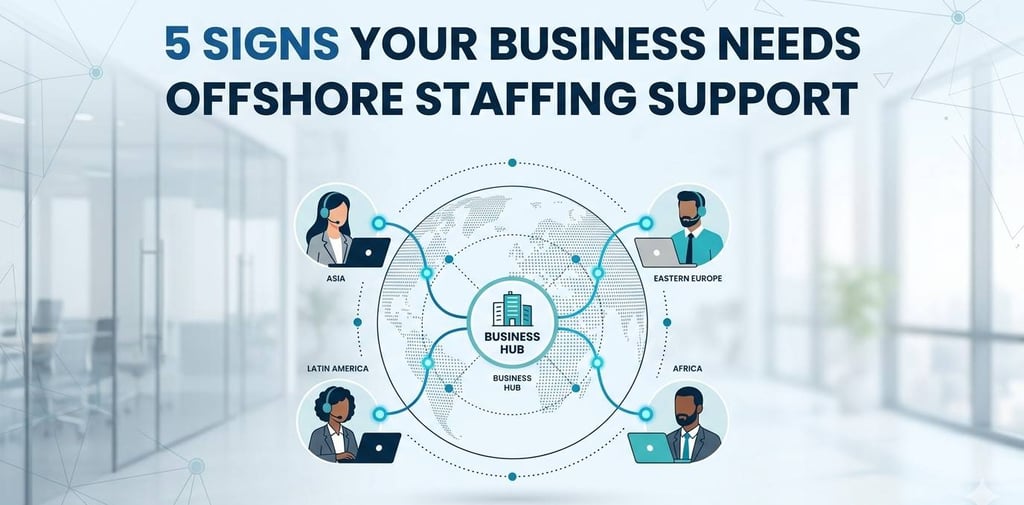
Businesses often reach a point where internal teams can no longer keep pace with operational demands. Consistent delays, rising workloads, difficulty hiring specialized talent, and declining service quality are common indicators that offshore staffing support may be necessary. Identifying these signs early helps maintain operational stability and prevents growth from creating bottlenecks.
The experience of managing distributed teams across multiple industries shows that offshore staffing is most effective when it addresses specific business challenges rather than serving as a reactive measure. This guide explains five clear indicators that suggest a business may benefit from offshore staffing support, along with practical considerations for evaluating the next steps.
Understanding When Offshore Staffing Becomes Necessary
Offshore staffing involves building dedicated remote teams that handle operational, administrative, technical, or customer-facing functions from another location. Businesses typically consider this approach when growth outpaces local hiring capacity or when specialized expertise becomes difficult to secure.
Market data supports this trend. According to the Deloitte Global Outsourcing Survey, access to talent and operational flexibility remain among the leading reasons organizations adopt offshore workforce strategies. Additionally, Gartner reports that global talent shortages continue to affect technology and support functions across multiple industries.
Sign 1: Your Team Is Constantly Missing Deadlines
When projects repeatedly run behind schedule despite employee effort, capacity limitations may be the root cause.
A growing workload often stretches internal teams beyond sustainable levels. Employees spend more time managing urgent tasks and less time focusing on strategic priorities.
Operational Indicators
Frequent project delays: Often indicate insufficient workforce capacity to handle current workloads effectively.
Backlogged tasks: Suggest resource allocation issues that prevent work from moving through processes efficiently.
Increased overtime: Signals an unsustainable workload distribution that places additional pressure on existing employees.
Delayed customer responses: Indicates support teams may be operating at maximum capacity and struggling to meet demand promptly.
Bonus Tip: Review task completion times over a 90-day period. Consistent increases often reveal staffing shortages before they become critical.
Sign 2: Hiring Specialized Talent Takes Too Long
Many businesses struggle to recruit professionals with specific technical or operational expertise.
Positions involving IT support, customer service management, data processing, and digital operations often remain vacant for extended periods. This slows business initiatives and increases pressure on existing employees.
Typical Talent Acquisition Challenges
Limited local talent pool: Often leads to longer recruitment cycles as businesses struggle to find qualified candidates within their geographic area.
High competition for skilled workers: Can result in increased vacancy periods as multiple employers compete for the same talent.
Specialized technical requirements: Reduce candidate availability because fewer professionals possess the exact skills and experience needed.
Rapid business growth: Creates situations where workforce demand exceeds hiring capacity, making it difficult to scale operations at the required pace.
According to ManpowerGroup's Talent Shortage Survey, employers worldwide continue to report difficulty filling skilled positions, particularly in technology-related roles.
Sign 3: Customer Service Quality Is Declining
Customer experience often reveals staffing problems before internal metrics do.
Longer response times, unresolved inquiries, and increasing complaint volumes indicate that support resources may no longer match customer demand.
Service Performance Warning Signs
Response speed
Healthy range: Consistently timely responses to customer inquiries.
Potential concern: Increasing delays that leave customers waiting longer for assistance.
Resolution rate
Healthy range: High first-contact resolution, with issues solved during the initial interaction.
Potential concern: Multiple follow-ups required before customer concerns are fully addressed.
Customer feedback
Healthy range: Stable customer satisfaction and positive feedback trends.
Potential concern: Growing complaints, negative reviews, or declining satisfaction scores.
Support queue volume
Healthy range: A manageable backlog that support teams can address within expected timeframes.
Potential concern: Persistent accumulation of tickets or requests that continue growing over time.
Businesses serving customers across multiple time zones frequently encounter these challenges as demand expands beyond traditional operating hours.
Sign 4: Administrative Work Is Consuming Core Business Time
Leadership teams often become involved in repetitive operational tasks when staffing resources are insufficient.
Administrative functions such as data management, reporting, documentation, scheduling, and customer follow-ups can gradually consume time intended for growth initiatives.
Tasks Commonly Shifted to Offshore Teams
Data Management: Improves operational efficiency by handling data entry, organization, processing, and record maintenance with greater consistency.
Administrative Support: Allows leadership and management teams to focus more on growth initiatives rather than routine operational tasks.
Customer Service: Provides faster response coverage and helps maintain service quality during periods of increasing customer demand.
Technical Support: Enhances issue resolution capacity by providing dedicated resources to manage troubleshooting, system monitoring, and user support.
Bonus Tip: Track how much time managers spend on repetitive administrative work each week. Significant time allocation often signals an opportunity for workforce restructuring.
Sign 5: Growth Opportunities Are Being Delayed
One of the strongest indicators is when business expansion plans remain on hold because existing teams cannot absorb additional responsibilities.
New product launches, market expansion efforts, customer acquisition campaigns, and technology upgrades frequently require workforce capacity beyond current staffing levels.
How Capacity Constraints Affect Growth?
Market expansion: Limited staffing can delay execution of expansion plans, making it harder to enter new markets or serve new customer segments effectively.
Customer acquisition: Reduced follow-up consistency may cause missed opportunities, lower conversion rates, and weaker customer engagement.
Product development: Insufficient resources can slow implementation timelines, delaying the release of new products, features, or services.
Technology upgrades: Workforce limitations often lead to extended project timelines, postponing system improvements and operational enhancements.
Research from McKinsey & Company highlights that organizations with scalable workforce models are often better positioned to respond to market opportunities and operational changes.
Key Differences Between Internal Expansion and Offshore Staffing
Workforce Scaling Approaches Compared
Recruitment timeline
Internal Hiring: Requires lengthy hiring cycles due to structured screening and onboarding processes.
Offshore Staffing Support: Enables faster scaling through access to pre-vetted global talent pools.
Talent availability
Internal Hiring: Limited by local workforce supply and geographic constraints.
Offshore Staffing Support: Offers broader access to global and specialized skill sets.
Operational flexibility
Internal Hiring: Works within a fixed structure that is slower to adjust.
Offshore Staffing Support: Allows more adaptable scaling based on workload changes.
Coverage hours
Internal Hiring: Restricted to standard business hours.
Offshore Staffing Support: Provides extended time-zone coverage for continuous operations.
Workforce scalability
Internal Hiring: Slower expansion due to formal hiring and restructuring processes.
Offshore Staffing Support: Easier and faster capacity scaling aligned with demand.
Factors Worth Evaluating Before Expanding Your Team
Before deciding whether offshore staffing support is appropriate, evaluate the following areas carefully:
Workflow Documentation
Are processes clearly documented?
Enables smooth onboarding and reduces dependency on informal knowledge transfer.
Communication Systems
Are reporting channels established?
Supports accountability and ensures alignment across distributed teams.
Data Security
Are access controls defined?
Protects sensitive business information and reduces operational risk exposure.
Performance Measurement
Are KPIs clearly tracked?
Maintains operational visibility and ensures consistent output monitoring.
Scalability Goals
Is future growth expected?
Supports long-term planning and helps align staffing models with expansion needs.
Bonus Tip: Pilot offshore support with a single department before expanding responsibilities across multiple functions.
Workforce Solutions Commonly Used for Business Growth
From the perspective of RD Global Business Solution, the following services are frequently aligned with businesses experiencing the challenges discussed above:
Workforce Acquisition
Supports the recruitment and onboarding of skilled professionals to address capacity gaps and operational demands.Customer Support
Helps manage growing customer interactions while maintaining service consistency across different time zones.IT & Tech Support
Provides technical expertise for system maintenance, troubleshooting, and operational continuity.Data Management
Assists with organizing, processing, and maintaining business-critical information efficiently.
Questions Decision-Makers Often Ask Before Proceeding
How quickly can staffing shortages affect customer experience?
Service quality can decline within weeks if growing customer demand consistently exceeds available support resources.
Which departments usually benefit first from offshore staffing?
Customer support, administrative operations, technical support, and data management functions are often among the earliest areas evaluated.
Does offshore staffing only benefit large companies?
No. Small and medium-sized businesses frequently use offshore teams to improve operational flexibility and access specialized expertise.
What should be measured before making a staffing decision?
Workload volume, project delays, customer response times, hiring challenges, and management capacity provide valuable indicators.
Answers to Important Long-Term Questions
How can offshore teams maintain quality standards over time?
Clear procedures, performance metrics, regular reviews, and structured communication processes help maintain consistency.
What management practices improve offshore team performance?
Defined responsibilities, measurable objectives, and scheduled feedback sessions contribute to stronger results.
Can offshore staffing support seasonal business fluctuations?
Yes. Many organizations use scalable staffing models to address periods of increased demand without permanently expanding internal teams.
How often should workforce needs be reassessed?
Quarterly workforce reviews help identify emerging capacity constraints before they affect operations.
What is the biggest mistake businesses make when scaling teams?
Expanding workloads without evaluating workforce capacity often creates inefficiencies that become difficult to reverse later.
Final Thoughts
Recognizing staffing limitations early allows businesses to maintain service quality, improve operational efficiency, and support sustainable growth. Repeated project delays, hiring challenges, declining customer experience, excessive administrative workloads, and stalled expansion efforts are among the clearest signs that additional workforce support may be required.
Evaluate operational demands objectively, measure workforce capacity regularly, and align staffing decisions with long-term business goals rather than short-term pressures.
Discuss Your Workforce Requirements
Businesses evaluating staffing strategies can benefit from an objective assessment of operational demands, workforce capacity, and growth objectives. RD Global Business Solution provides information on workforce acquisition, customer support, IT & Tech Support, and data management solutions for organizations exploring scalable workforce models.
For additional information or workforce-related inquiries, contact RD Global Business Solution at info@rdglobalbizsol.com or +971566249846.
Empowering your business with operational excellence solutions.
Al Moosa tower - 810 - 1 Sheikh Zayed Rd - Dubai







Solutions
Company
Contact
© 2026 RD Global Solutions. All Rights Reserved.


+971 56 624 9846

info@rdglobalbizsol.com